Data Centers Are Buildings Too: How Design Shapes the Infrastructure That Runs the World
The buildings that power the internet are, by most measures, the most technically demanding structures ever built. They are also, by most measures, the least considered from a design standpoint. That is a problem — and it is one that Tristan Scott Design is positioned to solve.
Every time you send a message, stream a video, run a search, or open an app, a request travels at the speed of light to a building you have almost certainly never seen. That building is a data center — and it is, by almost every technical measure, the most complex structure the construction industry produces. It requires more precise power distribution than a hospital, more sophisticated cooling than a semiconductor fab, and more redundant systems than a nuclear facility. It operates continuously, at scale, with no tolerance for failure.
And yet, for most of the history of the industry, data centers have been designed as pure utility. Blank facades. No landscaping. No consideration of the people who work inside them or the communities they occupy. The assumption has been that because no one sees the inside of a data center, no one needs to think about what it looks like.
That assumption is changing — and the firms that understand why it is changing are the ones that will define the next generation of digital infrastructure.
Why Data Center Design Matters More Than It Used To
Three forces are converging to make design a genuine competitive differentiator in the data center industry. The first is scale. Hyperscale campuses — the kind operated by Meta, Google, Amazon, and Microsoft — are no longer isolated industrial sites. They are campus-scale developments with hundreds or thousands of employees, located in communities that have legitimate interests in what gets built there. A facility that looks like a fortress sends a message. A facility that looks like a considered piece of architecture sends a different one.
The second force is talent. The people who operate and maintain data center infrastructure are skilled technical workers in a competitive labor market. The quality of the built environment — the lobby they walk into every morning, the break rooms, the NOC, the outdoor spaces — affects recruitment, retention, and daily performance. The firms that treat their facilities as workplaces rather than warehouses are building a structural advantage in the talent market.
The third force is brand. For hyperscale operators, the data center is increasingly a brand expression. Meta, Google, and Apple have all invested in data center architecture that reflects their brand identity — not because it improves PUE or reduces latency, but because it communicates something about who they are and how they operate. The facility is a statement. Design is the language that statement is written in.
What Full-Service Design Looks Like on a Data Center Project
At Tristan Scott Design, we approach data center projects the same way we approach any complex commercial engagement: with a full-service model that covers every phase from initial concept through construction-ready documentation. Here is what that looks like in practice.
Phase 1: Concept and Programming
Before a line is drawn, we work with the client to understand the operational requirements of the facility — power density, cooling strategy, security zones, traffic flows, expansion phasing — and translate those requirements into a spatial program. This is the phase where design and engineering meet. The best data center design does not fight the operational requirements; it expresses them. The cooling infrastructure becomes an architectural element. The security perimeter becomes a landscape strategy. The power distribution path becomes a circulation system.
Phase 2: Photorealistic Visualization
This is where Tristan Scott Design's capability is genuinely differentiated. Before a single permit is filed or a contractor is engaged, we produce photorealistic 3D visualizations of the facility — exterior campus views, lobby and reception spaces, server hall environments, NOC rooms, employee amenity areas. These are not schematic renderings or mood boards. They are photographic-quality images that show exactly what the finished facility will look like.
For data center clients, this capability has direct operational value. Visualizations allow facility planners to evaluate design decisions before they are committed to construction. They allow executives to present the project to community stakeholders, permitting authorities, and boards of directors with confidence. They allow the design team to identify and resolve conflicts between aesthetic intent and operational requirements before those conflicts become expensive change orders.
Phase 3: Interior Design and Material Specification
The interior of a data center is not just server halls. It includes lobbies, security vestibules, operations centers, conference rooms, break rooms, locker rooms, and in larger facilities, full employee amenity spaces including fitness centers, cafeterias, and outdoor areas. Each of these spaces requires the same quality of design thinking as any commercial interior — material selection, lighting design, furniture specification, wayfinding, and brand integration.
At Tristan Scott Design, we bring the same standard of interior design to data center support spaces that we bring to luxury residential and commercial projects. The result is a facility where the human environment matches the technical precision of the infrastructure it supports.
Phase 4: Construction Documentation
The final phase is the one that most design firms treat as an afterthought — and the one that determines whether the design actually gets built. Construction documents are the technical drawings that tell contractors, subcontractors, and inspectors exactly what to build. For a data center, where coordination between structural, mechanical, electrical, and plumbing systems is extraordinarily complex, the quality of the construction documents directly affects the cost, schedule, and quality of the finished facility.
At Tristan Scott Design, construction documentation is produced by the same person who designed the space and produced the visualizations. There is no translation layer between the design intent and the technical documentation. The drawings reflect the design because they were produced by the designer — not handed off to a documentation team working from a set of sketches and assumptions.
The Speculative Concept Work: Meta Campus Designs

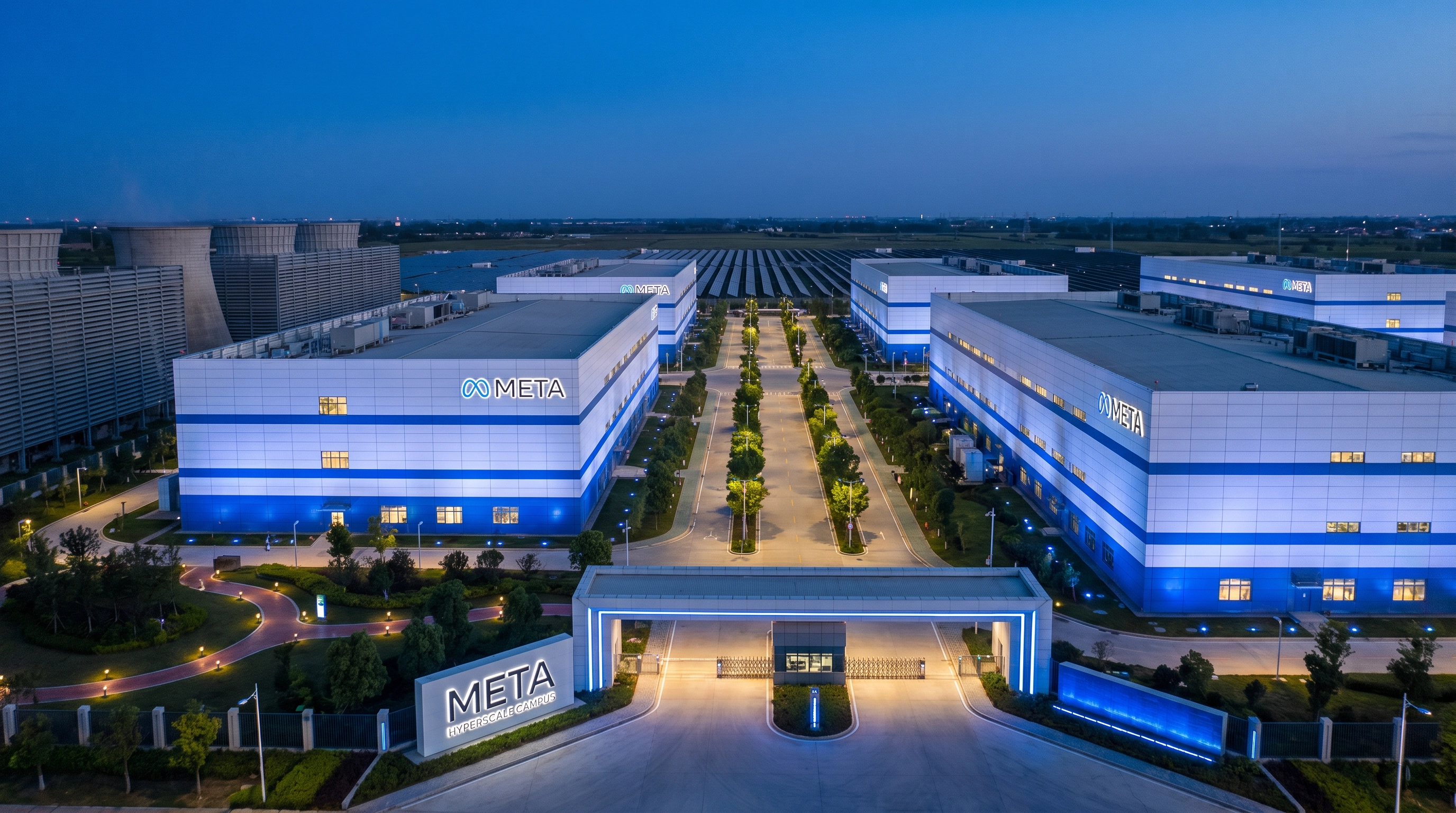
To demonstrate what this full-service approach looks like applied to hyperscale data center design, Tristan Scott Design has produced a series of speculative concept visualizations for three Meta data center campus scales: a small edge campus, a medium regional campus, and a large hyperscale campus. These are not commissioned work — they are concept designs produced to show what is possible when design thinking is applied to digital infrastructure at every scale.
The small edge campus concept demonstrates how a 50,000 sq ft facility can integrate into a desert landscape with a welcoming, architecturally considered presence. The medium regional campus concept shows how a 300,000 sq ft multi-building development can create genuine campus identity through landscape, solar infrastructure, and courtyard programming. The large hyperscale campus concept addresses the challenge of making a million-square-foot facility feel like a place rather than a warehouse — through monumental entry design, boulevard landscaping, architectural louver systems that screen mechanical infrastructure, and bold brand expression at a scale visible from the highway.
All three concepts are available to view in the Tristan Scott Design portfolio.

Who This Work Is For
The clients who benefit most from this approach are hyperscale operators and colocation providers who are building or expanding facilities in markets where community relations, talent recruitment, and brand expression are genuine business priorities. They are general contractors and development firms who need a design partner capable of producing construction-ready documentation that reflects the full complexity of the project. They are real estate developers who are converting or developing industrial sites for data center use and need a designer who understands both the operational requirements and the design opportunity.
If you are planning a data center project — at any scale, at any phase — and you want to understand what a full-service design and visualization engagement looks like, contact Tristan Scott Design. The conversation starts with your project requirements and ends with a facility that works as hard as the infrastructure inside it.
Ready to see what your data center campus could look like? Contact Tristan Scott Design for a free consultation. We work with hyperscale operators, colocation providers, and commercial developers nationwide.