Your Design Firm May Be Local. Your Project Team May Not Be.
A prestigious local name does not always mean your drawings and renderings are being produced locally. The real question is not where the firm has an office. It is who is doing the work, who owns the decisions, and how quickly problems get solved.
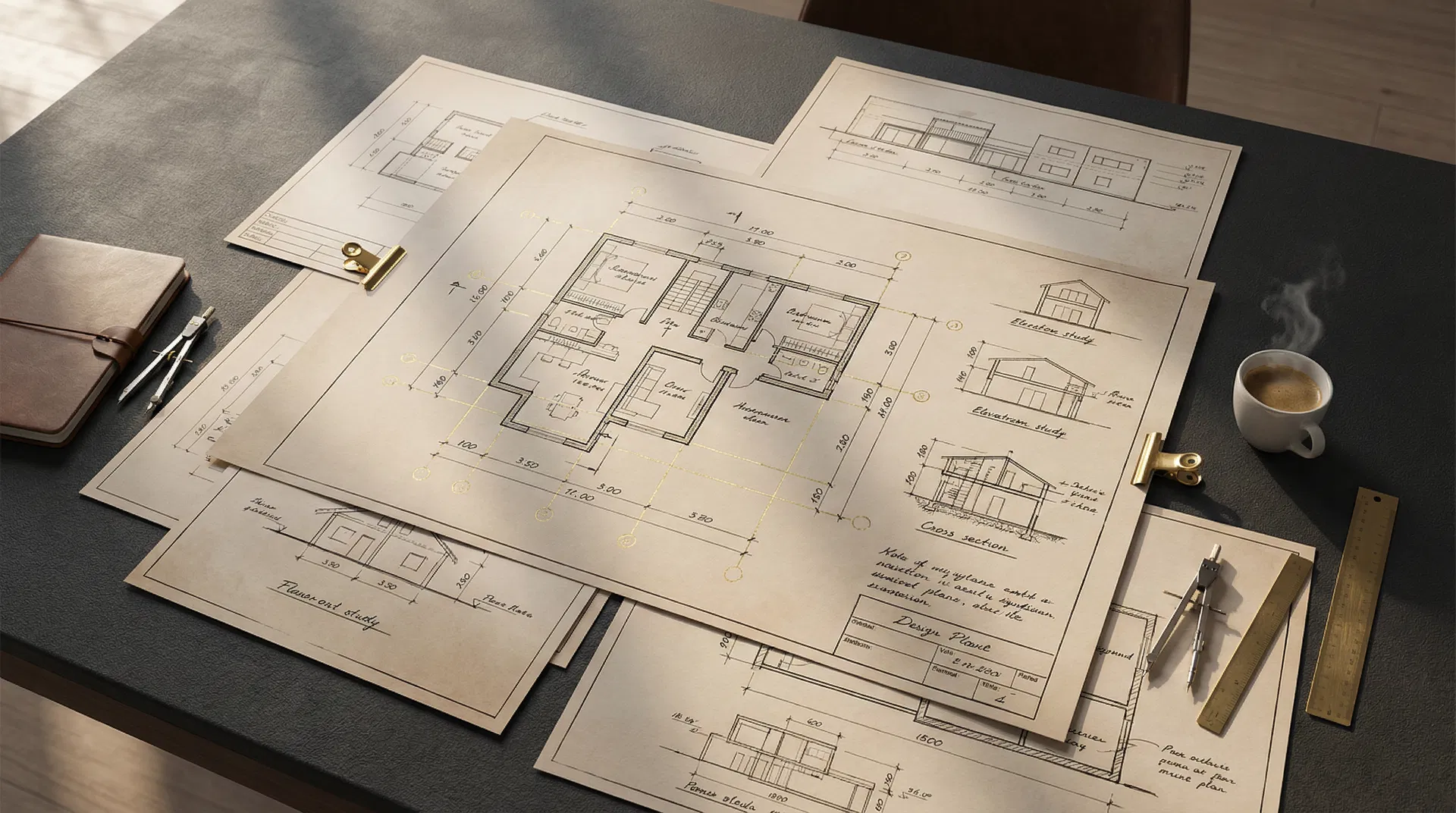
A prestigious local name does not always mean your project is being designed, drafted, or rendered by a local team. Across architecture and interior design, it has become increasingly common for firms to keep the client relationship in the United States while sending production work to lower-cost teams overseas.
Sometimes that model works. Offshore specialists can add capacity, extend production hours, and handle clearly defined tasks. But when a firm uses outsourcing primarily to protect margin—without telling the client who is doing the work, where that person is located, or how their work is being reviewed—the savings can become an illusion.
The client may be paying a premium local fee for a process built around distant handoffs, delayed clarification, and layers of management. The project looks cheaper on an internal spreadsheet. It does not necessarily move faster in the real world.
This is not an argument against global talent. It is an argument against fragmented accountability.
The Hourly Rate Is Not the Project Cost
Offshore outsourcing is usually sold through one number: the hourly rate. If a production team can draft, model, or render for a fraction of a domestic rate, the decision can look obvious. But design is not an assembly line. A drawing is connected to a site condition. A detail is connected to a material. A floor plan is connected to a client's behavior, a contractor's sequence, a municipality's expectations, and dozens of decisions that evolve as the project moves forward.
The moment production becomes separated from context, the firm must spend time rebuilding that context through markups, meetings, written instructions, uploads, downloads, reviews, and corrections. Every handoff creates another opportunity for information to be simplified, misunderstood, or lost.
| What the proposal shows | What the project may absorb |
|---|---|
| Lower drafting or rendering rate | More management, explanation, review, and rework |
| Production continues overnight | A simple question can wait an entire workday for an answer |
| Large remote labor pool | Changing team members and inconsistent project knowledge |
| More files produced | Less direct ownership of whether those files solve the right problem |
Research summarized by Harvard Business School found that each additional hour of time-zone separation was associated with an 11% decline in synchronous communication among employees in a large multinational organization. The asynchronous messages did not disappear; the real-time conversations did. Collaborative employees often compensated by shifting their work into early mornings and evenings.[1]
That matters in design because the fastest path through a difficult problem is often a five-minute conversation between the people who understand it. When that conversation becomes a markup sent at 4:00 p.m., reviewed twelve hours later, returned with a question, and clarified the following afternoon, one decision can consume two or three days.
Design Suffers When the Person Drawing It Cannot Ask Why
Architecture and interior design are full of instructions that look objective but are actually contextual. "Move the wall six inches" sounds simple until that wall affects millwork, lighting, mechanical distribution, ceiling geometry, furniture clearance, and the view from the entry. A production team can execute the redline perfectly and still damage the design if no one explains why the wall existed in the first place.
A 2024 peer-reviewed construction study found that the major consequences of miscommunication were project delay and lower work quality.[2] The study was not specifically about offshore drafting, and it would be dishonest to pretend it was. Its lesson is broader and more important: complex building projects punish weak information flow.
Offshore work becomes risky when it adds communication boundaries without adding an equally strong coordination system. If the overseas team cannot speak directly with the client, has never seen the site, does not understand local construction practices, and receives instructions only through a project manager, the person producing the work is separated from the people living with its consequences.
The Problem Is Not Geography. It Is Opacity.
I am not going to tell you that every offshore team produces poor work. That would be false. There are exceptional architects, designers, drafters, and visualization artists working in every part of the world. There are also domestic teams producing weak work five miles from the project.
The real issue is whether the delivery model is transparent and accountable. Research published in IEEE Transactions on Engineering Management treats sourcing model, coordination practices, and value as separate questions—because outsourcing outcomes depend on how the relationship is structured, not simply where the people are located.[3]
A well-managed global team can be effective when responsibilities are clear, the work is appropriately scoped, direct communication is possible, standards are documented, and a qualified local professional maintains responsible control. An opaque model is different. The client believes they hired one team while another team produces the work. The local firm becomes a messenger. The remote team becomes a production department. Nobody fully owns the gap between them.
If outsourcing is part of the process, clients deserve to know. They should be told which work is being outsourced, who reviews it, where responsibility sits, and what happens when a contractor needs an answer immediately.
Why This Matters to American Design Businesses
Small practices are not a niche part of American architecture. According to the American Institute of Architects, roughly 75% of the more than 19,000 architecture firms in the United States have fewer than ten employees. Twenty-eight percent are sole practitioners.[4] These firms train emerging talent, build regional expertise, maintain relationships with local trades, and give clients direct access to decision-makers.
The same AIA report says the share of national billings generated by smaller firms fell by half between 2015 and 2023, while the share generated by larger firms increased. That does not prove outsourcing caused the shift. It does show the competitive reality small firms are facing.
The domestic profession also depends on a continuing pipeline of experience. The U.S. Bureau of Labor Statistics counted 123,600 architect jobs in 2024 and projects about 7,800 openings per year through 2034.[5] Junior professionals do not become experienced project leaders by watching production happen somewhere else. They develop judgment by drawing details, resolving conflicts, visiting sites, hearing contractor questions, and seeing the consequences of their decisions.
When a profession removes too much entry-level production from its local offices, it may save money today while weakening the experience base it will need tomorrow.
Small Studios Cannot Win a Race to the Bottom
A small American studio will not beat a global production vendor on hourly labor cost. Trying to do so is a losing strategy. We have to compete on the things a distant production pipeline cannot easily replicate: judgment, context, speed of clarification, continuity, and direct responsibility.
At Tristan Scott Design, that means staying close to the problem. We measure existing properties ourselves. We develop floor plans, build the 3D model, design the architecture and interiors, produce photorealistic renderings, and develop construction-ready documentation as one connected process. The person discussing the idea with the client is not separated by three layers from the person testing it in the model.
That integration is why our design process can move quickly without asking a client to accept ambiguity. It is why projects such as the Williams Circle Residence can move from on-site documentation through multiple floor-plan options, engineering coordination, full-service design, and visualization with one continuous design intent.
We also use technology aggressively. Small firms should automate repetitive administration, build reusable standards, use visualization to resolve decisions earlier, and use AI as leverage. But technology should compress the distance between thinking and doing—not create another anonymous layer between the client and the work.
Seven Questions Every Client Should Ask
1. Who will actually produce my drawings and renderings?
2. Is any part of the work being outsourced, and will I be told which part?
3. Will the person doing the work attend design and coordination meetings?
4. Who has visited or documented the site?
5. Who verifies local code, constructability, and consultant coordination?
6. How quickly can the team answer a contractor's question during business hours?
7. Who is personally accountable if the documents conflict?
These are not protectionist questions. They are project-management questions. A client has the right to understand the delivery system they are paying for.
How Small Studios Adapt—and Win
The answer is not to pretend global competition does not exist. The answer is to become radically better at the parts of the work that require trust.
Small firms need to make access a product: direct communication with the person making the decisions. They need to make speed visible: same-day clarification instead of multi-day handoff cycles. They need to make certainty tangible through photorealistic visualization, coordinated documents, clear revision histories, and defined responsibility. And they need to build partnerships with local engineers, contractors, vendors, and permitting professionals that create real regional knowledge.
There is also an opportunity to support other American firms through transparent domestic production. Our design and visualization services can give architects, interior designers, developers, and contractors additional capacity without asking them to build a hidden, fragmented workflow. The work can still be fast. It can still be scalable. But it remains accountable.
Do not compete with offshore labor by becoming cheaper. Compete by becoming closer to the problem, faster with the answer, and impossible to misunderstand.
The Bottom Line
Offshore outsourcing is not automatically irresponsible, and domestic production is not automatically excellent. The dividing line is ownership. Who understands the project? Who is available when the plan changes? Who can explain why a decision was made? Who will answer when the contractor finds a conflict?
The design industry should stop treating those questions as operational details hidden behind the brand name on the proposal. They are the project.
At Tristan Scott Design, we are adapting by doing more—not by disappearing behind a cheaper production pipeline. We are combining local site knowledge, principal-led design, photorealistic visualization, coordinated documentation, and direct communication into one accountable studio. That is how a small business competes. Not by pretending to be the biggest firm in the room, but by being the firm closest to the work.
Want to know exactly who is designing your project? Book a free consultation with Tristan Scott Design. Firms that need additional domestic design or visualization capacity can contact the studio directly to discuss fit and availability.
References
- Harvard Business School Working Knowledge, “Global Talent, Local Obstacles: Why Time Zones Matter in Remote Work.”
- Ain Shams Engineering Journal, “Causes of miscommunication leading to project delays and low work quality in the construction industry of Saudi Arabia.”
- IEEE Transactions on Engineering Management, “Outsourcing and Offshoring Engineering Projects: Understanding the Value, Sourcing Models, and Coordination Practices.”
- American Institute of Architects, “The latest insights from the 2024 Firm Survey Report.”
- U.S. Bureau of Labor Statistics, Occupational Outlook Handbook: Architects.